FHA Loan vs Conventional Loan
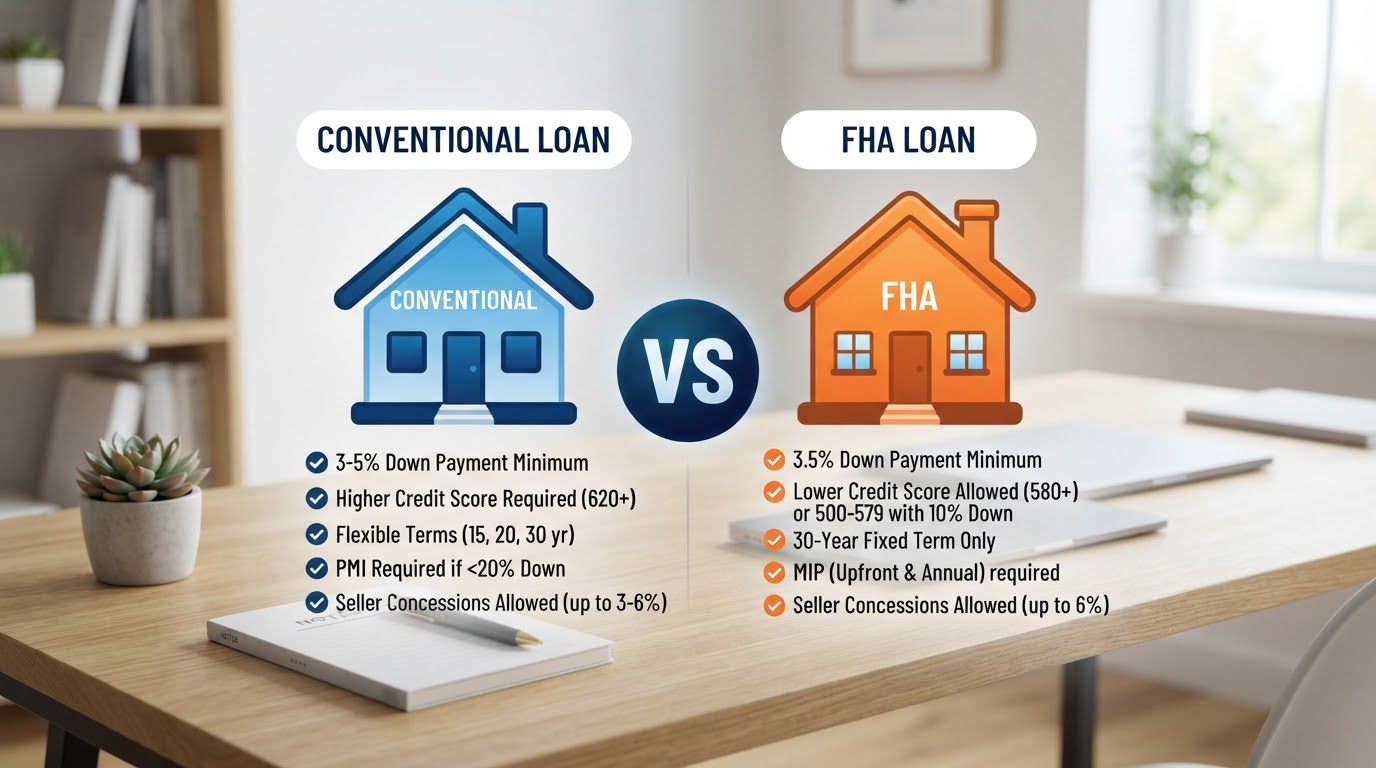
FHA and conventional loans are the two most common mortgage types. This side-by-side comparison breaks down the real differences in down payment, credit, mortgage insurance, and total cost.
FHA and conventional loans are the two most widely used mortgage programs in the United States. They serve overlapping but distinct borrower profiles, and choosing between them is one of the most consequential decisions in the mortgage process. The wrong choice can cost thousands of dollars over the life of the loan.
This comparison looks at the factors that actually differ between the two programs: down payment, credit score requirements, mortgage insurance, property standards, loan limits, and total cost over time. The goal is to give you a clear framework for deciding which loan fits your situation.
Down Payment Comparison
FHA loans require a minimum down payment of 3.5% for borrowers with a FICO score of 580 or above. Conventional loans typically require a minimum of 5% down, though some conventional programs allow 3% down for first-time buyers with strong credit.
The difference between 3.5% and 5% on a $400,000 home is $6,000. For a borrower who has been saving but has not yet reached the conventional threshold, FHA can make homeownership possible sooner. For a borrower who already has 5% or more, the down payment advantage of FHA is less significant.
Both programs allow down payment gift funds from family members, but the documentation requirements differ slightly. FHA has more established gift fund procedures, while conventional lenders may scrutinize the source and seasoning of gift funds more closely.
Credit Score Requirements
The FHA minimum FICO score is 580 for the 3.5% down option, with scores between 500 and 579 allowed at 10% down. Many FHA lenders apply overlays requiring 620 or higher. Conventional loans generally require a minimum FICO score of 620, but the best rates and terms go to borrowers with scores above 740.
FHA rates are less sensitive to credit score than conventional rates. A borrower with a 660 FICO score may see a similar FHA rate to a borrower with a 700 score. On a conventional loan, that same 40-point difference can meaningfully change the rate and the mortgage insurance cost.
This is why FHA often makes sense for borrowers in the low to mid 600s, while conventional becomes more cost-effective as credit scores climb above 680.
Mortgage Insurance: The Biggest Difference
Mortgage insurance is where the two programs diverge most significantly. FHA loans require both an upfront premium of 1.75% of the loan amount and an annual premium that, for most loans with less than 10% down, lasts for the life of the loan.
Conventional loans require private mortgage insurance, called PMI, only when the down payment is less than 20%. Critically, conventional PMI can be removed once the loan reaches 80% loan-to-value, either through payments, appreciation, or a combination. FHA MIP, on most loans, cannot be removed without refinancing.
This difference compounds over time. A borrower who pays FHA MIP for 10 years on a $300,000 loan at 0.55% annually pays roughly $16,500 in mortgage insurance over that period. A conventional borrower who reaches 20% equity in year five stops paying PMI at that point, saving thousands in the remaining years.
Property Standards and Loan Limits
FHA appraisals include a condition inspection in addition to a value assessment. If the property does not meet FHA minimum standards, required repairs must be completed before closing. Conventional appraisals focus primarily on value and are generally less stringent on property condition.
This makes FHA loans slightly more challenging for properties that need work, though the FHA 203(k) rehab loan can address this by financing repair costs into the loan. For move-in-ready homes, the property standard difference rarely matters.
FHA loan limits vary by county and are set annually by HUD. In most counties, the limit aligns with the conforming loan limit, but in high-cost areas, the FHA limit is higher. Conventional conforming loans have a single national limit, with jumbo loans available above that threshold. If you are buying a higher-priced property, check whether the FHA limit in your county covers the purchase price.
Which Loan Is Right for You
FHA tends to fit borrowers with a credit score below 680, a down payment under 5%, and a plan to live in the home as a primary residence. If you expect your credit and equity to improve, FHA can be a bridge to a conventional refinance later.
Conventional tends to fit borrowers with a credit score above 680, at least 5% down, and a goal of eliminating mortgage insurance once equity reaches 20%. If you plan to hold the loan long-term, the ability to drop PMI can save significant money.
The most reliable way to decide is to compare both options with real numbers based on your actual profile. We run both scenarios so you can see the total cost over the time you expect to own the home, not just the monthly payment at closing.
We run FHA and conventional numbers side by side for nearly every borrower whose profile allows both. The decision almost always comes down to two questions: how long do you expect to hold this loan, and is your credit likely to improve enough to refinance out of FHA mortgage insurance?
If the answer is that you expect to refinance within three to five years, FHA is often the better starting point. If the answer is that you plan to hold the loan for 10 years or more, conventional usually wins on total cost because the mortgage insurance comes off. We show you both totals so the decision is based on math, not on which loan is easier to sell.
Frequently Asked Questions
Have Questions About FHA Loans?
Talk to the Funding Department. We will review your situation honestly and show you every option that fits.
By the Funding Department, Keystone Home Loans & Realty
The Funding Department at Keystone Home Loans & Realty helps borrowers across all 50 U.S. states navigate purchase and refinance lending decisions with clear, options-focused guidance.