FHA Loans: Pros and Cons
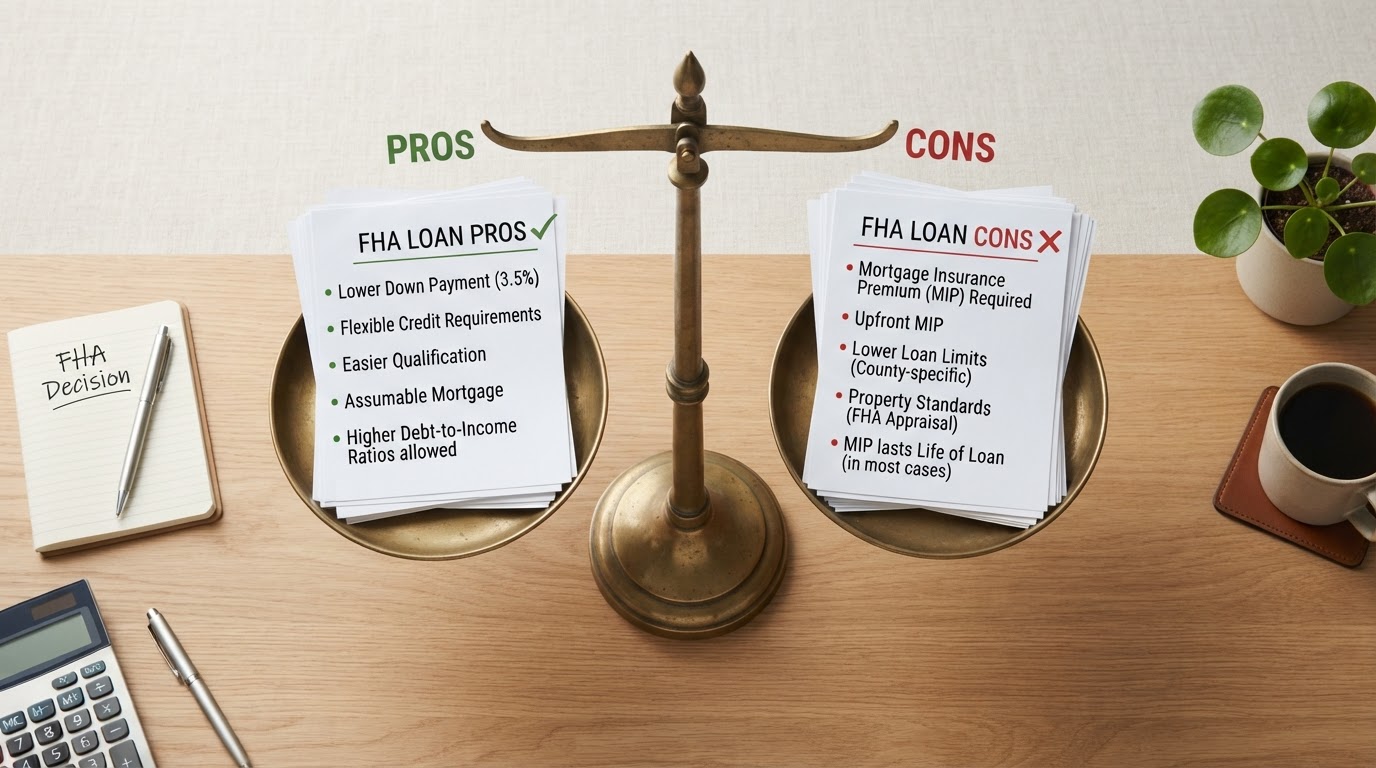
FHA loans make homeownership possible for many borrowers, but the mortgage insurance and property standards are real tradeoffs. Here is an honest look at where the program helps and where the costs show up.
Every loan program has strengths and tradeoffs. The FHA loan is no exception. It was designed to expand access to homeownership, and it does that well for borrowers who have smaller down payments or credit histories that do not meet conventional standards. The tradeoffs are not hidden, but they are often misunderstood.
This guide gives you a balanced view of the pros and cons of FHA loans so you can make an informed decision. The goal is not to sell you on the program. It is to help you see where it fits your situation and where a different loan type might serve you better.
The Pros of FHA Loans
The most significant advantage of an FHA loan is the low down payment. At 3.5% of the purchase price, the barrier to entry is lower than most conventional loans, which typically require 5% or more. For a borrower who has steady income but limited savings, this can be the difference between buying now and waiting another year or more.
FHA loans also offer more flexible credit qualifications. The FHA minimum FICO score is 580 for the 3.5% down option, and many lenders accept scores in the low 600s. Conventional loans generally require 620 or higher, and the best rates go to borrowers above 740. If your credit is still building, FHA can be the more realistic path.
Another advantage is that FHA loans are assumable. A future buyer who qualifies can take over your FHA loan at its existing rate. In a higher-rate environment, this can be a selling feature that adds value to your home. Not every loan type offers this.
Down payment gift funds are allowed, and down payment assistance programs can often be combined with FHA financing. This expands the pool of resources you can use to get into a home.
The Cons of FHA Loans
The biggest tradeoff is mortgage insurance. FHA loans require two forms of mortgage insurance: an upfront premium paid at closing or financed into the loan, and an annual premium paid monthly. For most borrowers with 3.5% down, the annual premium lasts for the life of the loan. This is a real monthly cost that adds to your payment.
Conventional loans also require mortgage insurance with less than 20% down, but that insurance can be removed once you reach 20% equity. FHA mortgage insurance, on most loans originated after 2013, cannot be removed without refinancing into a different loan type. This is a meaningful long-term cost difference.
FHA property standards are stricter than conventional appraisals. The FHA appraisal includes a basic condition inspection, and if the appraiser identifies required repairs, they must be completed before closing. This can complicate purchases of older homes or fixer-uppers, though a specialized FHA 203(k) rehab loan can address some of these situations.
FHA loans are limited to primary residences. You cannot use an FHA loan to buy an investment property or a second home. If your goal is to build a rental portfolio, you will need a different financing strategy.
When FHA Makes the Most Sense
FHA loans tend to fit borrowers who have a credit score in the low to mid 600s, a down payment of less than 5%, and a plan to live in the home as their primary residence. If you are a first-time buyer who has been saving but does not yet have 20% down, FHA can get you into a home years sooner than waiting.
FHA also works well for borrowers who expect their credit and equity to improve over time. You can start with an FHA loan, build equity through payments and appreciation, and refinance into a conventional loan later to drop the mortgage insurance. This is a common and legitimate strategy.
The key is to run the numbers on total cost over the time you expect to hold the loan, not just the monthly payment at closing. A loan that is cheaper today but carries mortgage insurance for 30 years may cost more than a conventional loan with slightly higher upfront requirements.
When a Conventional Loan May Be Better
If your credit score is above 680 and you have 5% or more to put down, a conventional loan often costs less over time because the mortgage insurance can be removed at 20% equity. The monthly mortgage insurance on a conventional loan is also typically lower than the FHA annual premium.
Borrowers buying higher-priced properties may also find conventional loans more suitable because FHA loan limits vary by county. In high-cost areas, the FHA limit is higher, but it still caps the purchase price you can finance. Conventional conforming and jumbo loans have different limit structures.
The right way to decide is to compare both options side by side with real numbers. We run both scenarios for borrowers in this position so they can see the total cost, not just the monthly payment.
The most common mistake we see is borrowers assuming FHA is always the cheaper option because the down payment is lower. It is cheaper at closing, yes. But if you hold the loan for 10 years and the mortgage insurance never comes off, the total cost can exceed a conventional loan that started with a slightly higher payment.
Our approach is simple. We run both FHA and conventional numbers whenever your profile allows it. If FHA is clearly the better fit, we say so. If conventional saves you money over the time you expect to own the home, we show you that too. The decision should be based on math, not on which loan is easier to originate.
Frequently Asked Questions
Have Questions About FHA Loans?
Talk to the Funding Department. We will review your situation honestly and show you every option that fits.
By the Funding Department, Keystone Home Loans & Realty
The Funding Department at Keystone Home Loans & Realty helps borrowers across all 50 U.S. states navigate purchase and refinance lending decisions with clear, options-focused guidance.